



Worker housing can look like a cost, but the numbers tell a different story. Here’s why farms should treat it as a serious investment.


HUGE SALE NOW ON MODULAR HOUSING! MASSIVE SAVINGS UP TO $30,000
Farm owners know how to justify a tractor, header, ute or shed.
But worker housing often gets treated differently.
It gets seen as a cost.
That’s worth challenging.
If poor worker housing makes it harder to attract workers, keep workers, or get people on site ready to work, then it’s not just a housing problem.
It’s a business problem.
And like most business problems, it’s worth putting some numbers around it.
Let’s say a farm needs accommodation for 20 workers.
The current Pastoral Award pay guide lists the Farm and Livestock Hand Level 2 casual ordinary hourly rate at $31.19 from 1 July 2025. The actual rate depends on the role, award, classification and employment type, so this is only a working example.
| Farm example | Number |
| Workers needing accommodation | 20 |
| Example hourly rate | $31.19 |
| Hours per week | 40 |
| Wage cost per worker per week | $1,247.60 |
| Wage cost for 20 workers per week | $24,952 |
| Wage cost over 26 weeks | $648,752 |
So before fuel, machinery, inputs or overheads, this example farm already has nearly $650,000 tied up in labour over 26 weeks.
That labour needs somewhere decent to live.
Poor or unavailable housing doesn’t always show up as one clean invoice.
It shows up as travel time, people leaving, absenteeism, stress, delays and workers choosing another farm.
AHURI research says a lack of affordable and available regional housing can place workers in poor-quality housing and make it harder for regional businesses to attract and retain workers.
Now let’s put numbers against it.
| Problem | Simple example | Cost |
| Workers staying in town, 30 minutes away | 20 workers × 1 hour/day × 5 days × 26 weeks × $31.19 | $81,094 |
| Extra missed days | 20 workers × 3 days × 8 hours × $31.19 | $14,971 |
| Two workers leave and need replacing | 2 × 40% of a $64,875 wage equivalent | $51,900 |
| Total possible leakage | $147,965 |
That’s not a perfect figure.
It’s a simple model.
But it shows the point clearly.
If poor housing is costing the business travel time, lost days and turnover, the leakage can become serious very quickly.

Replacing workers costs money.
Gallup estimates that replacing a frontline worker can cost around 40% of salary. For technical roles, it estimates around 80%.
Using the same $31.19 hourly rate at 40 hours per week:
| Turnover example | Cost |
| Annual wage equivalent | $64,875 |
| 40% replacement cost | $25,950 |
| 80% replacement cost | $51,900 |
So if better worker housing helps keep even one or two good people, it can make a real difference.
That’s why smart farm owners don’t only look at the cost of the unit.
They look at the cost of not solving the problem.
Let’s say the farm invests in five 4-bedroom modular worker housing units.
That gives 20 beds.
For this example, we’ll allow $200,000 per unit as a simple working number.
That’s not a quote.
It’s just easy maths.
| Modular worker housing example | Number |
| Units | 5 |
| Bedrooms per unit | 4 |
| Total beds | 20 |
| Example cost per unit | $200,000 |
| Total investment | $1,000,000 |
| Example value after 15 years | 25% |
| Residual value | $250,000 |
| Net cost over 15 years | $750,000 |
| Annual net cost | $50,000 |
So the annual cost, after allowing a 25% residual value, is about $50,000 per year.
Again, this is only a model.
But it’s a useful one.
Here’s the important bit.
| Break-even view | Cost |
| Annual net cost | $50,000 |
| Workers housed | 20 |
| Cost per worker per year | $2,500 |
| Cost per worker per day, year-round | $6.85 |
| Cost per worker per day over 26 weeks | $13.74 |
That’s the question.
Could better worker housing save or create more than $13.74 per worker per day over a 26-week season?
For many farms, that’s not a high bar.
If it reduces travel time, helps keep workers, cuts absenteeism, improves reliability, or helps fill positions faster, the numbers can start to stack up.
This is where modular worker housing is different from a fixed building.
A fixed building is usually tied to one location.
A modular unit can give you more options.
Depending on the design, approvals, transport access and services, modular worker housing may be moved, added to, repurposed or on-sold later.
That means the unit might start as seasonal worker housing.
Later, it might be used for contractors, a manager, guests, family overflow, or another site.
That flexibility matters.
That’s the point of Real Living. Delivered.
It’s not about flash accommodation.
It’s about quality-built housing that works for real people, in real places, and keeps working as an asset.
Before buying the next piece of gear, ask these questions.
| Question | Why it matters |
| Are workers travelling because there’s nowhere decent to stay? | Travel time can chew up money fast. |
| Are good workers leaving because the accommodation isn’t good enough? | Replacing people is expensive. |
| Are roles harder to fill because housing is poor or unavailable? | Labour is already tight. |
| Could better housing help workers stay longer? | Retention often beats recruitment. |
| Could modular housing be reused later? | A flexible asset can keep delivering value. |
ABARES reported that monthly hours worked in agriculture fell to 9.3 million in August 2025, 9% below the three-year average and the lowest level since the series began in 1984.
That doesn’t mean every farm has the same labour problem.
But it does show why worker availability can’t be taken for granted.
A farm doesn’t make money from equipment sitting still.
It makes money when good people turn up, work well and stay.
That’s why worker housing should be looked at like any other farm investment.
Not soft.
Not sentimental.
Commercial.
If poor housing is costing you time, people, reliability or growth, then better worker housing may be one of the clearest investments on the table.
Smart operators know good housing keeps good people.
And when it’s modular, it’s not just accommodation.
It’s a flexible asset built to support your workers, your operation and your long-term return.

Download your copy of our Accommodation Guide.
Aruva’s experienced team will collaborate with you about our modular accommodation solutions.

Talk to us about your property, timeline and requirements.

We’ll supply a proposal based on your design preference.

Place your order! We’ll build and install your new modular accommodation.
There’s no place like home, right? Your staff can spend their evenings in comfort and style, relaxing and connecting with friends and family, and then recharge their batteries with some quality zzzzs.


Our Resources
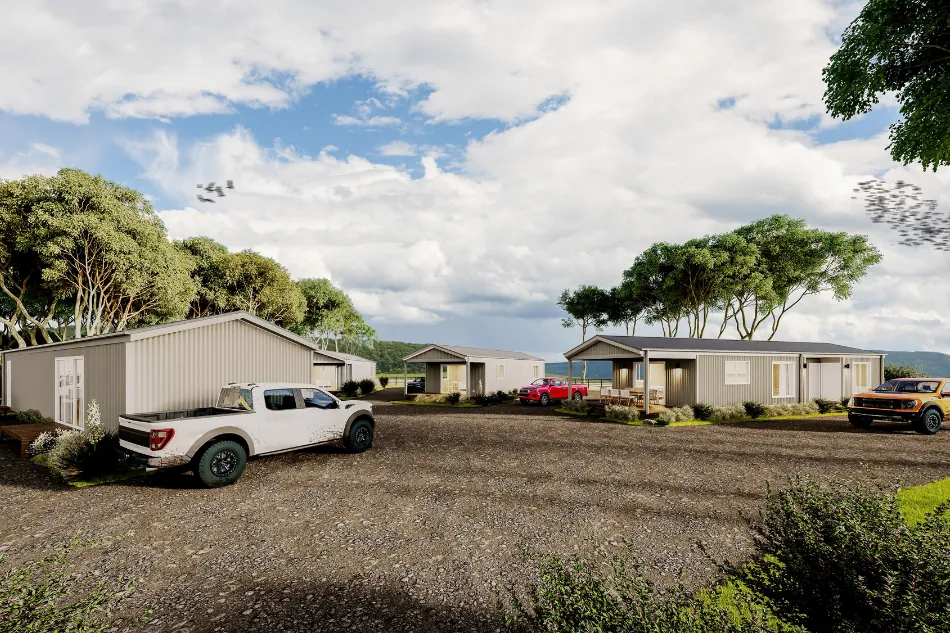
Learn how scalable worker housing helps farm operators meet current demand, plan for growth and avoid committing to excess capacity too early.

Planning multiple modular housing units? Learn what to check for power, water and wastewater before you lock in site layouts or unit numbers.
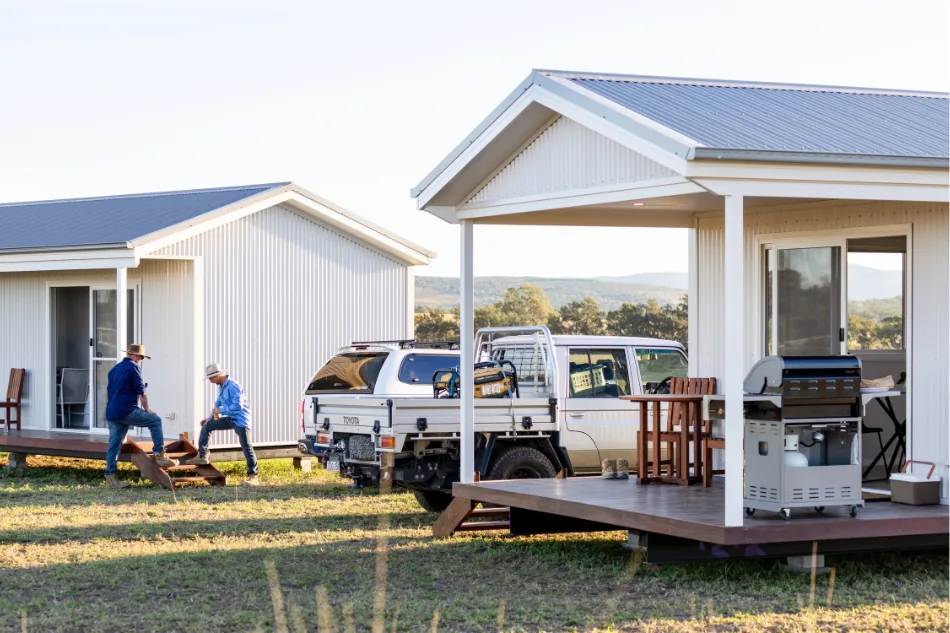
Modular housing cost Australia explained: see the seven budget areas beyond the unit price, from freight and footings to approvals and services.