



A practical modular worker accommodation kitchen needs storage, fridge space, easy meal prep and simple clean-up for real worker routines.


HUGE SALE NOW ON MODULAR HOUSING! MASSIVE SAVINGS UP TO $30,000
A modular worker accommodation kitchen isn’t the same as a normal kitchen in a family house.
It has a different job.
It’s not there to impress guests. It’s not mainly for entertaining. And it’s usually not built around one family sharing the same fridge, pantry and cooking routine.
It’s there to help workers store food, make meals, clean up and get on with their day.
That might sound basic, but it matters.
Smart farm managers know that good housing keeps good people. And the kitchen is a big part of that. If the kitchen doesn’t work, the accommodation doesn’t work.
So what makes a kitchen practical in modular worker accommodation?
In most cases, it comes down to three things.
This is the part people often underestimate.
In a normal house, one family usually shares the fridge and pantry.
In worker accommodation, you may have two, three or four adults sharing the same kitchen. They’re not necessarily sharing food. Each person may have their own groceries, meals, snacks, drinks and meal prep.
That means fridge space matters.
Freezer space matters too.
In regional, rural and remote areas, workers may not be ducking down to the shops every night. They may shop once a week, or even less often. They may need to stock up because the nearest decent supermarket is a fair drive away.
So a small fridge in a shared unit can quickly become a daily frustration.
For a one-bedroom unit, a standard setup may be enough. But once you move into two, three or four-bedroom units, cold storage needs more thought.
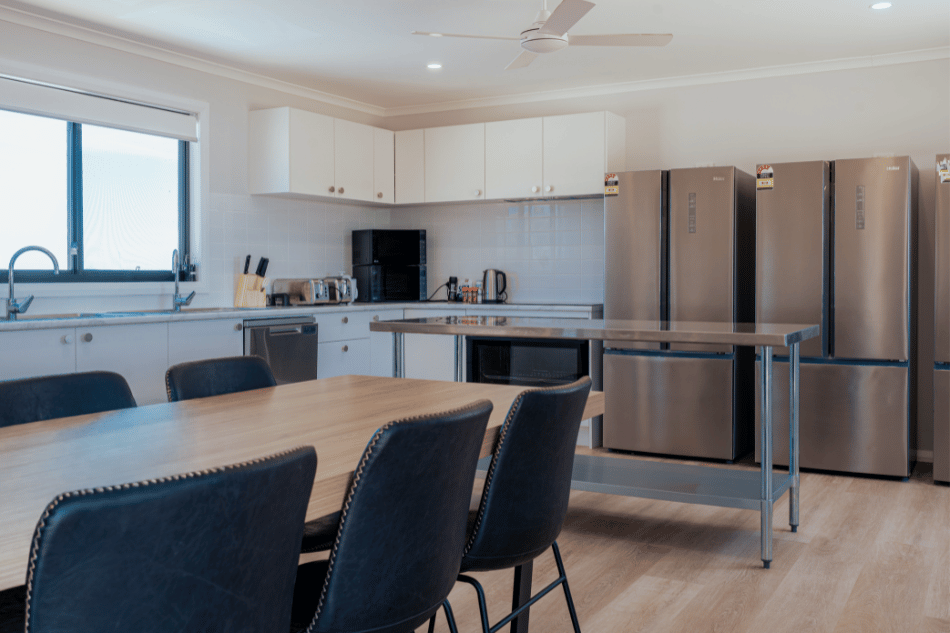
In larger accommodation setups, multiple fridges or freezers may make more sense than one large appliance. It can make the space easier to use and help workers keep their food separate.
Pantry space matters for the same reason.
Each worker needs somewhere sensible to put their food. If there’s not enough space, the kitchen gets messy fast. Food ends up on benches, in bedrooms, or jammed into cupboards that were never designed for it.
That’s not good living.
A practical modular worker accommodation kitchen makes it easy for people to store their own food without fighting for space.
Most worker accommodation kitchens aren’t chef’s kitchens.
That doesn’t mean workers don’t cook. Some do.
But the kitchen needs to suit real life.
Many workers are starting early, finishing late, coming in tired, or heading back out again. They may be reheating leftovers, making toast, packing lunch, cooking something simple, or using pre-prepared meals.
That’s why the microwave matters.
In a normal residential kitchen, people often focus on the oven. In worker accommodation, the microwave may get used more than almost anything else.
That doesn’t mean you leave out the oven. A single oven is still useful.
But double ovens, huge feature cookers and fancy cooking setups usually aren’t the priority.
In most worker accommodation kitchens, the better focus is:
Power points are worth calling out.
Workers may use kettles, toasters, sandwich presses, air fryers, rice cookers, coffee machines and phone chargers. If there aren’t enough power points, people start using double adaptors and extension leads.
That’s not ideal.
A practical kitchen makes the common things easy.
Make breakfast. Heat dinner. Pack lunch. Make coffee. Clean up. Get out the door.
That’s the daily rhythm the kitchen needs to support.
This is where dishwashers come in.
At first, a dishwasher may sound like a luxury in worker accommodation.
It usually isn’t.
In shared accommodation, a dishwasher can help keep the kitchen cleaner. It can also reduce tension between people, especially when several workers are using the same plates, mugs, cutlery and cookware.
No one wants to come into a shared kitchen after a long day and find dishes stacked in the sink.
A dishwasher doesn’t fix everything, but it helps.
The same thinking applies to sinks, benchtops, splashbacks, cupboards and flooring.
The kitchen should be easy to wipe down. It should be tough enough for daily use. It shouldn’t have delicate finishes that mark easily or fiddly design features that make cleaning harder.
This is where residential feel and commercial toughness need to meet.
The kitchen should feel decent to use. It shouldn’t feel cheap, temporary or clinical. But it also needs to handle real use from real people.
That’s what practical worker accommodation is about.
Most modular worker accommodation kitchens fall into one of two broad setups.
The first is a self-contained unit.
This could be a one, two, three or four-bedroom unit with its own kitchen, bathroom and living area. In this setup, the kitchen needs to suit the number of workers living in that unit.
A four-bedroom unit needs more fridge space, more storage and better shared-use planning than a one-bedroom unit.
The second setup is a separate kitchen or amenities hub.
This is common where workers sleep in separate bedroom modules and use a central kitchen, dining, laundry or amenities building.
In that case, the kitchen has to support more people. It may need multiple fridges, multiple microwaves, more than one sink, more bench space and better flow through the dining area.
That kind of kitchen isn’t really a house kitchen.
It’s more like a service hub.
Workers come in, store food, make meals, sit down, clean up and head back out.
The layout needs to match that.
Not everything belongs in a worker accommodation kitchen.
In most cases, you probably don’t need:
That doesn’t mean the kitchen should be cheap or bare.
There’s a big difference between practical and poor quality.
Cheap hinges, weak cabinetry, bad layouts and tiny fridges will cause problems. Workers notice these things because they live with them every day.
The aim is to spend money where it actually makes life better.
That usually means storage, fridge space, durability, power points, easy cleaning and a layout that doesn’t get in people’s way.
Worker accommodation is often judged by the bedrooms and bathrooms first.
Fair enough.
People need privacy, sleep and decent bathroom facilities.
But the kitchen affects daily life in a big way. It affects food storage, routines, hygiene, comfort and how well people live together.
That’s why the kitchen shouldn’t be an afterthought.
Smart farm managers who are investing in worker housing to lift retention know the small daily things matter. A well-planned kitchen won’t solve every staffing challenge, but a poorly planned one can make life harder than it needs to be.
A good kitchen helps create real living conditions, not just a place to sleep.
That’s the point.
Real Living. Delivered. isn’t about adding flash features. It’s about making accommodation work properly for the people using it every day.
When you’re planning a modular worker accommodation kitchen, don’t start with the question, “What would look nice?”
Start with a better question:
How will the people living here actually use this kitchen every day?
Can they store enough food?
Can they make a meal quickly?
Can they clean up without drama?
Can several people use the kitchen without getting in each other’s way?
Those questions will usually lead you to the right answer.
A good modular accommodation supplier should be able to talk you through this. They should understand the difference between a one-bedroom unit, a four-bedroom shared unit and a larger kitchen hub.
Because in worker accommodation, the kitchen doesn’t need to be fancy.
It needs to work.

Download your copy of our Accommodation Guide.
Aruva’s experienced team will collaborate with you about our modular accommodation solutions.

Talk to us about your property, timeline and requirements.

We’ll supply a proposal based on your design preference.

Place your order! We’ll build and install your new modular accommodation.
There’s no place like home, right? Your staff can spend their evenings in comfort and style, relaxing and connecting with friends and family, and then recharge their batteries with some quality zzzzs.


Our Resources

Planning multiple modular housing units? Learn what to check for power, water and wastewater before you lock in site layouts or unit numbers.
Modular housing cost Australia explained: see the seven budget areas beyond the unit price, from freight and footings to approvals and services.
Worker housing costs go beyond the build. See how vacancies, overtime, travel and management time can raise the cost of inadequate housing.